If you’re looking to reduce paint formulation costs, using the right calcium carbonate filler is the lowest-risk way to achieve this. When ground calcium carbonate is used correctly, it not only allows you to replace up to 5% of titanium dioxide (TiO₂) in paint, it helps you protect whiteness, finish and film performance.
Where does the money go in paint formulations?
Two ingredients drive costs in most decorative paints, namely, 1) titanium dioxide (TiO₂) and 2) binder. TiO₂ gives your paint good opacity power, and binder holds the film together. Both raw materials are expensive and driven by global price swings.
This is where extenders and fillers come into play. Calcium carbonate costs far less per kilogram.
So what role does calcium carbonate play in paint?
Ground calcium carbonate (GCC) is not a like-for-like replacement for TiO₂. Rather, it helps TiO₂ work more efficiently within your paint formulation. Because GCC has a refractive index similar to most binders, it contributes little direct hiding power. Its main value is that it helps reduce overall formulation cost while supporting important properties such as whiteness, finish, viscosity, and film performance. Here’s what it does:
- Bulk filler = lower costs
- A low oil-absorption filler needs less binder
- It keeps paint bright and white
- Its particle size drives smoothness, feel and sheen for silk finishes to flat matts
Where do the savings come from?
There are three ways formulators can cut costs:
- Replace up to 5% TiO₂ with Ultrafine GCC, while keeping the remaining TiO₂ well spaced so that opacity holds up
- Replace other more expensive extenders with GCC that ends up giving you a similar paint finish
- Increase the filler loading in matt or budget-friendly paints by choosing a low oil-absorption grade that helps keep binder demand under control
Often some of the best formulators use a combination of the above. It is however, advised to change one thing at a time and test for the best results.
Where to be careful
You’re only saving on costs if your paint still passes key test. Watch for possible limitations:
- Critical PVC: Adding too much GCC filler and the binder will no longer coat every particle. Your scrub resistance, stain resistance and durability drops sharply.
- Particle size: Choose a calcium carbonate grade that’s too course and you’ll lower gloss level and be left with a rough feel
- Acidic conditions: GCC reacts with acids and is not suitable for low-pH systems or acid-resistant coatings
Run a ladder study to test cost-savings
An easy way to validate cost savings is by running a test using a simple ladder study. Your formulation becomes the control measure, then slowly add 3 –4 versions (e.g. replace 5% TiO2 with Ultrafine GCC at first, then step it up in small increments). During each test, compare opacity, whiteness, sheen, viscosity, scrub resistance and shelf-life stability.
Make sure you start with right calcium carbonate grade
At Serina Trading, we stock three ASCOM calcium carbonate grades for paint and coatings, and one Ultrafine grade. The range is held locally across Durban, Cape Town and Johannesburg, with full technical data sheet support.
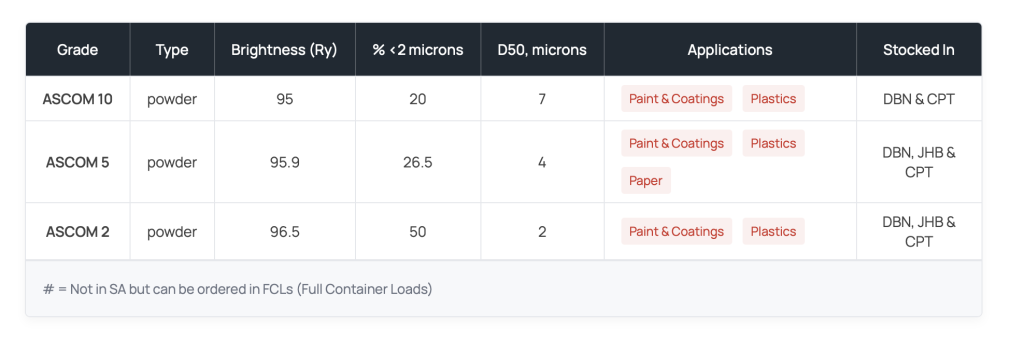
Not sure where to start? Request a technical data sheet or sample, or speak to our team about your formulation by emailing enquiries@kaolin.co.za