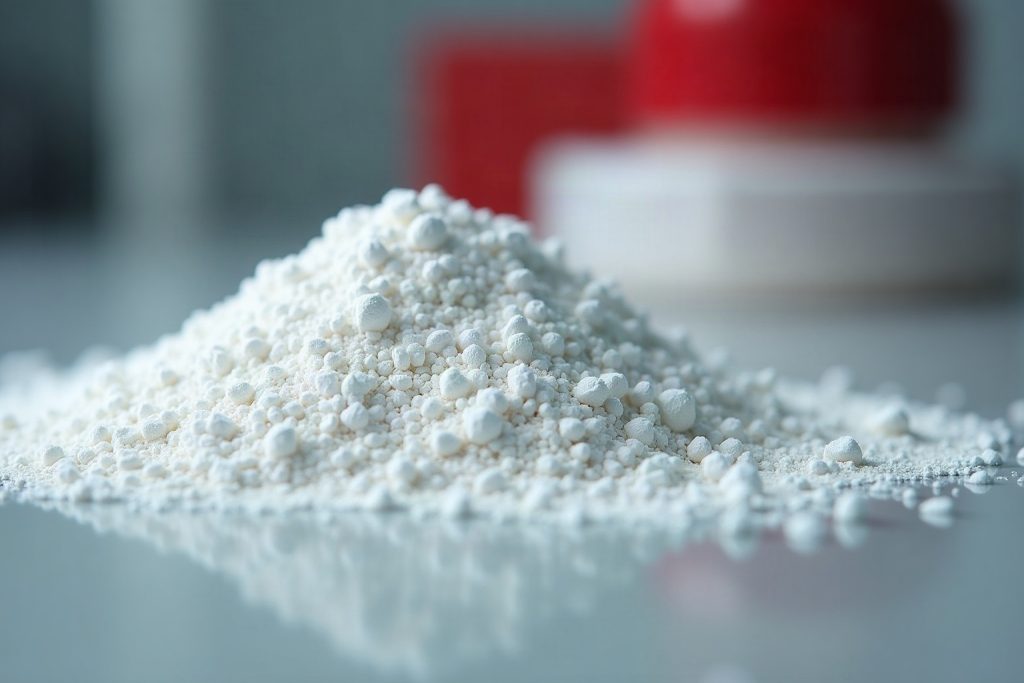
So what exactly is coated calcium carbonate and why do we need to coat it?
Natural calcium carbonate is hydrophilic. That means it likes water, but is pretty unfriendly towards organics like polymers. Yet the plastics industry needs a cheap white filler just as much as anyone else!
If you mix ground calcium carbonate into plastics, the high surface energy of the particles cause a lot of friction, which you don’t want.
Luckily we can modify the surface of the particles to reduce this friction and make them hydrophobic. There are several ways to do this, but the most common method is to use a surfactant like stearic acid.
Stearic acid comes from a family of compounds called fatty acids. The neat thing about stearic acid is its long organic chain with an acidic end bit. This means one end likes organics and the other end likes inorganics!

The acidic end part on the right attaches nicely to the polar surface of the calcium carbonate. Then the long non-polar tail sticks out around the particle, changing it from being hydrophilic to hydrophobic. Hey Presto!
The trick of course is to get a single layer of stearic acid molecules around the filler particle. To do this, we must not add too much – about 1% is about right. It depends on the surface area, actually – a finer grade will need more than a coarser grade.
To produce this coated filler, a solution of stearic acid is sprayed onto dry calcium carbonate. Then it is milled to get an even coating of the particles.
The result is a beautiful, hydrophobic white filler ready for use in all sorts of plastic applications. Be careful when you handle it though. It sticks like crazy to anything organic, especially humans!
So if you are making PVC pipes, this filler imparts strength and whiteness. More important of course, are the savings you enjoy by replacing some expensive polymer.

The main coated grade used in South Africa is a 2-micron grade (D50). Ours is called ASCOM 50T, or “A50T” for short. However you may be interested to know we can supply other particle sizes too, either coarser or finer than 2-microns. Please contact us for more information.